RESERVATION IS NOT A POVERTY ALLEVIATION TOOL,ITS A WEAPON FOR SOCIAL JUSTICE
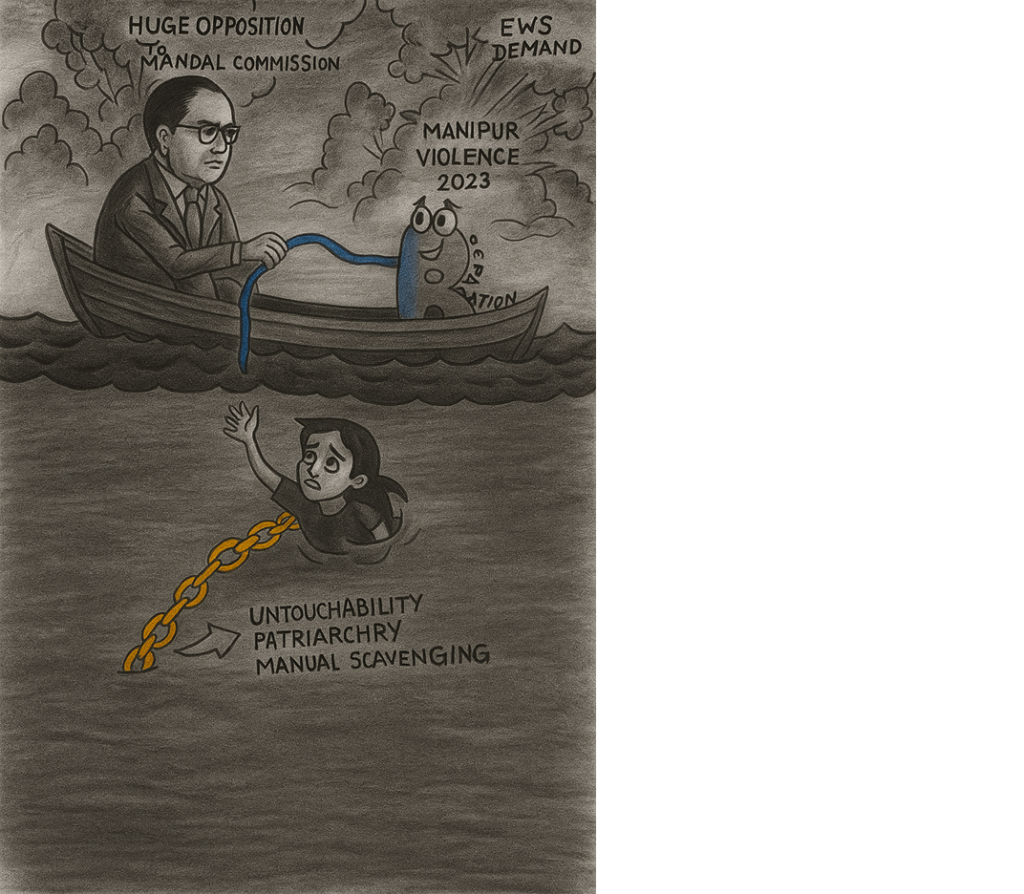
Caricature by Blue Sea. Colour of saffron for the chain represents the barriers that drag the socially backwards from achieving their equal status in society in every aspects and partial blue for the reservation represents the social justice which is still a blind vision of Baba Saheb.
RESERVATION IS NOT A POVERTY ALLEVIATION TOOL, IT’S A WEAPON FOR SOCIAL JUSTICE.
Hi, I’m Blue Sea. The widespread misconception arising in the young minds in recent years is “ Why do rich SC/ST get reservation but poor general category people are not getting it?” and many questions whisper in the young minds, such as :
“Q 1. After getting admission in a higher educational institution, every student, whether belonging to a reserved category or unreserved, gets similar access to classes, library, teachers, labs, etc. Despite this, why is a reserved category candidate entitled to the benefit of reservation while applying for a job?
Q 2. But isn’t it unfair that despite studying together in the same institution, one gets a job due to a reservation, whereas the other doesn’t? Merit is also compromised under reservation.
Q 3. Despite providing reservations in employment, caste-based discrimination has continued. In such a situation, is reservation an answer to contain discrimination?
Q 4. Why should reservations not be permitted on the grounds of economic backwardness?
Q 5. Isn’t a poor candidate belonging to a higher caste equally vulnerable as a Dalit?”
We should focus on article 15(4) to find the answer to such questions, which shows that reservation is for socially and educationally backward classes of citizens.
It is often forgotten that caste reservation does not benefit all of the poor. Thus, in our country, constitutional coercion is being used to conceal the true intent of affirmative action in the form of reservation, as well as the truth of the caste system, and the entire concept of reservation is being attacked.
Caste is the main weapon of discrimination and exploitation in our country, and its nature is different from that of other countries. Caste is not only a tool of discrimination here, but it is also the bedrock of Hindu society, and it not only ensures but also supports the grossly unequal distribution of resources and power in society. In fact, Shudras and Atishudras are not part of the Hindu society.
The main purpose of reservation is to bring the Dalits and Tribals, who have been pushed to the corners for thousands of years, into the mainstream of society. Reservation alone will not empower the Scheduled Castes and Tribes, but many other efforts will have to be made along with reservation. The purpose of reservation is not only economic empowerment. Reservation is a multi-pronged effort to increase the representation of disadvantaged groups in education and government jobs.
● The constitutional provisions governing reservation are, Part XVI deals with reservation of SC and ST in Central and State legislatures.Article 15(4) and 16(4) of the Constitution enabled the State and Central Governments to reserve seats in government services for the members of the SC and ST.
● The Constitution was amended by the Constitution (77th Amendment) Act, 1995 and a new clause (4A) was inserted in Article 16 to enable the government to provide reservation in promotion.
● Later, clause (4A) was modified by the Constitution (85th Amendment) Act, 2001 to provide consequential seniority to SC and ST candidates promoted by giving reservation.
● Constitutional 81st Amendment Act, 2000 inserted Article 16 (4 B) which enables the state to fill the unfilled vacancies of a year which are reserved for SCs/STs in the succeeding year, thereby nullifying the ceiling of fifty percent reservation on total number of vacancies of that year.
● Article 330 and 332 provides for specific representation through reservation of seats for SCs and STs in the Parliament and in the State Legislative Assemblies respectively.
● Article 243D provides reservation of seats for SCs and STs in every Panchayat. Article 233T provides reservation of seats for SCs and STs in every Municipality.
● Article 335 of the constitution says that the claims of STs and STs shall be taken into consideration constituently with the maintenance of efficacy of the administration.
The State of Madras v. Smt.Champakam Dorairajan (1951) case was the first major verdict of the Supreme Court on the issue of Reservation. The case led to the First Amendment in the Constitution. The Supreme Court in the case pointed out that while in the case of employment under the State, Article 16(4) provides for reservations in favour of the backward class of citizens, no such provision was made in Article 15. Pursuant to the Supreme Court’s order in the case, the Parliament amended Article 15 by inserting Clause (4).
“When the reservation is for dominant classes, then everything is fine. But if the hardworking but deprived classes of the country get a share, the quality is disrespected”.